"Where is a cosy vegan-friendly spot for a group of 4 with a table available at 7 PM?"
That is one of Google’s own example queries for Ask Maps, its new conversational feature inside Google Maps. It also explains the shift better than any product announcement could.
The local-SEO playbook just changed. For 15 years, ranking on Google Maps mostly meant the right keywords, citations, review count, and basic trust signals. With Ask Maps, Google is using Gemini to read across 300 million places’ reviews, photos, and attributes to match conversational queries. If those signals are not in your profile in the right form, you may not show up, even if your old-school keyword work is solid.
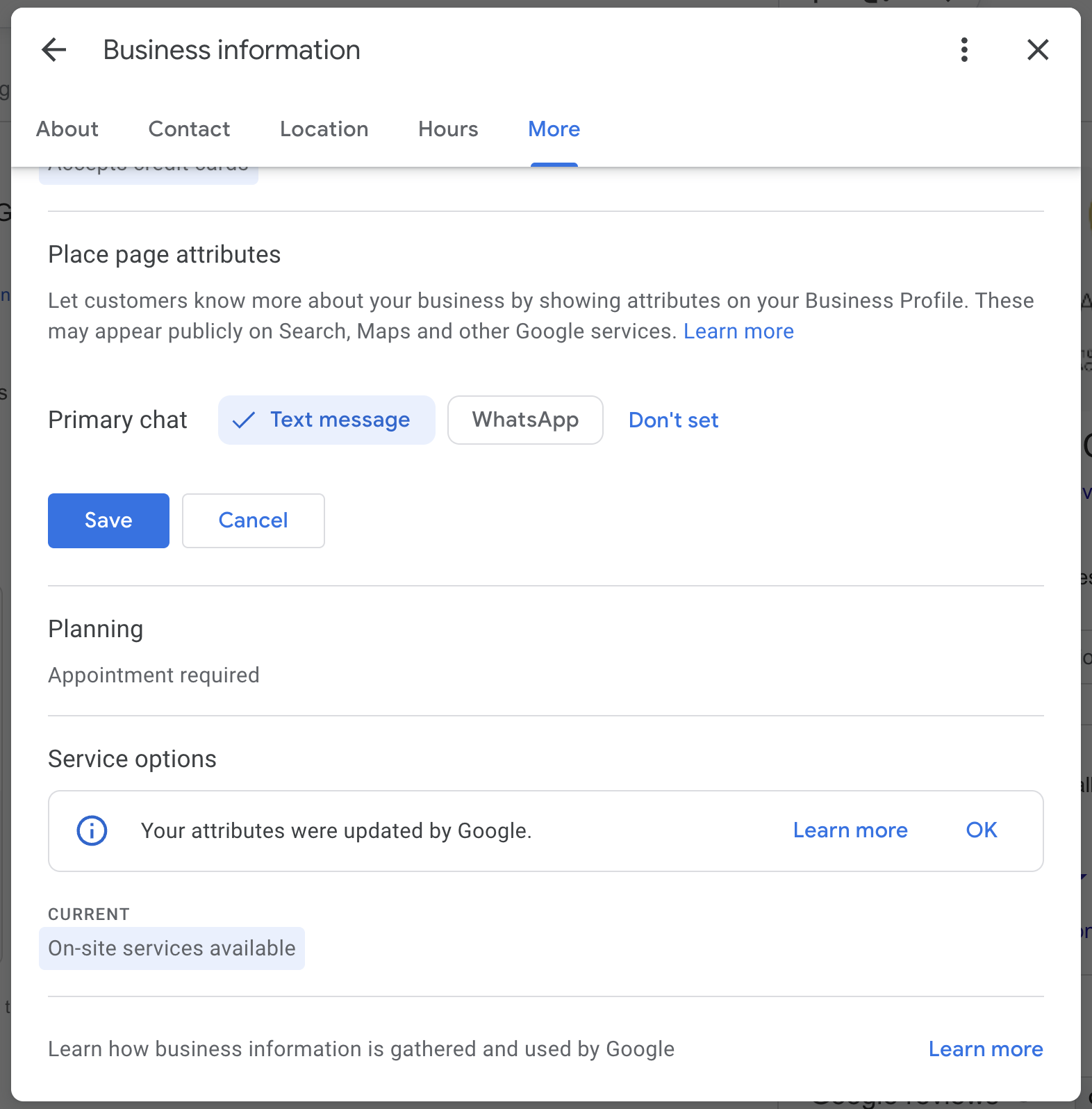
Your Google Business Profile, or GBP, is the free business listing that appears on Google Search and Google Maps. It is the thing customers use to check your hours, call you, get directions, read reviews, browse photos, and decide whether you look legitimate. Until now, many businesses treated GBP optimisation like a checklist: category selected, services added, a few photos uploaded, reviews coming in. Ask Maps makes that too shallow. Your business is now being read by an AI, not just matched by a keyword index. That is a different game.
What "Ask Maps" actually is (and what it isn't)
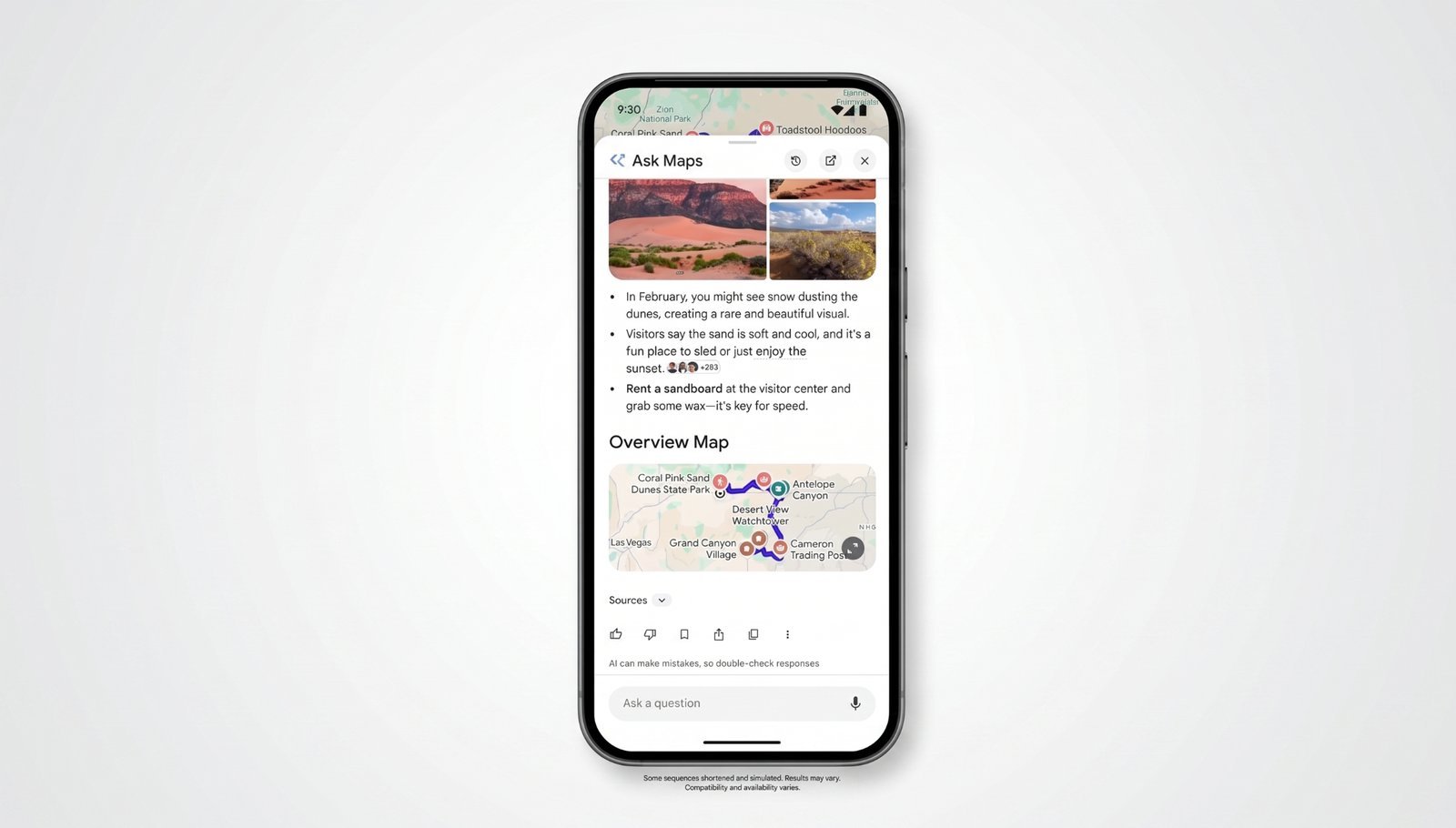
Ask Maps is Google’s new conversational layer inside Maps. Maps, short for Google Maps, is a map app and a map-based search panel where local businesses appear. Ask Maps lets users ask full questions instead of typing short keyword searches.
Gemini is Google’s family of AI models, the same technology behind Google’s other AI tools. In Ask Maps, Gemini tries to understand what a person actually means when they search. A query like “vegan restaurant near me” is a keyword search. A query like “Where is a cosy vegan-friendly spot for a group of 4 with a table available at 7 PM?” is a conversational query, meaning it is worded as a normal sentence or question.
That changes the matching process. Google is no longer only looking for a business near the searcher with the right category and enough reviews. It has to infer whether a place is cosy, vegan-friendly, suitable for a group, open at the right time, and bookable.
Google described Ask Maps in its April 2026 GBP newsletter like this:
"It 'reads' your reviews for mentions of your atmosphere, scans your photos to verify you have outdoor seating, and checks your real-time attributes to see if you're accessible or pet-friendly."
This process represents an inference model across multiple signal types rather than basic keyword matching.
What does not change? GBP is still the source of truth. Citations still matter. Citations—any place on the web where your business NAP (Name, Address, Phone) details appear, such as Yelp, Yellow Pages, or industry directories—still matter. Maintaining NAP consistency across the web still builds essential trust signals. Reviews still matter, too. They are just being used differently.
Google also says Ask Maps “analyses data from 300 million places.” That scale matters. Your profile is not competing only on category, distance, and review count anymore. It is competing on how clearly Google can understand what your business is actually like.
The 4 signals Ask Maps actually reads
1. Reviews — for vibe, atmosphere, accessibility
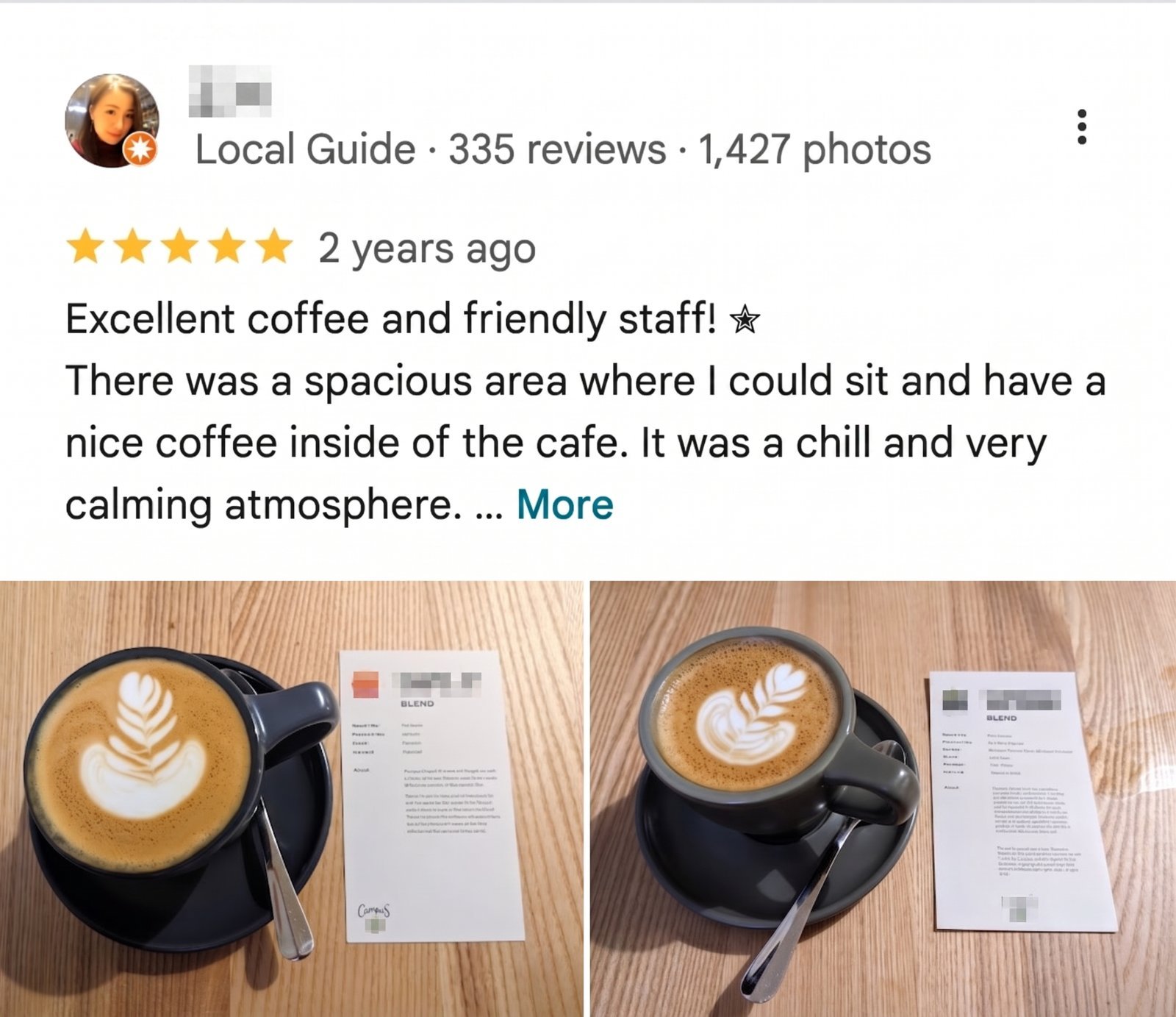
Ask Maps reads review text for descriptive language. It looks for the kinds of words real customers use when they describe a place: “quiet,” “loud,” “great for groups,” “wheelchair accessible,” “vegan-friendly,” “easy parking,” “good with kids,” “romantic,” “fast,” “relaxed,” or “professional.”
This is where many businesses are weak. A 5-star review that says “great service!” feels good, but it gives Ask Maps almost nothing useful. It does not explain who the business is good for, what the customer experienced, what the space feels like, or which features matter.
A café with 300 generic reviews may still be hard for Ask Maps to match to a query like “quiet café with outdoor seating where I can work for two hours.” A smaller competitor with 60 detailed reviews mentioning shade, laptop-friendly tables, calm atmosphere, good Wi-Fi, and outdoor seating may give Google more usable evidence.
The practical fix is not to fake reviews. It is not to coach customers by saying, “Please mention our outdoor seating.” That crosses a line and can create spam patterns. The better approach is to prompt for better detail in your review request. Ask customers what they came in for, who they came with, what they ordered, what problem you solved, whether parking was easy, or how they found the space.
You are not telling them what to write. You are asking better questions, so real customers leave more useful reviews.
A review like this gives Ask Maps four usable signals; a 5-star 'great service!' gives it zero
2. Photos — for visual verification of attributes
Ask Maps does not only read text. Google says it scans photos to verify what a business claims.
That means your photo gallery is no longer just there to make your profile look nice. It is evidence. If your GBP says you have outdoor seating, your photos should show outdoor seating. If your profile says you are wheelchair accessible, your photos should show the entrance, ramp, doorway, or relevant access point. If your restaurant claims a family-friendly setup, your photos should make that setup visible to AI image recognition.
Photos also affect customer behaviour directly. According toGoogle’s 2026 GBP Best Practices Playbook, businesses with photos get 42% more direction requests on Google Maps. Theofficial companion playbook adds that 90% of people are more likely to visit a business with photos on Google Search and Maps, helping customers “see why they should choose you.”
The practical fix is simple: upload photos that prove the attributes and features you want to be found for. One clear photo of outdoor seating supports the “outdoor seating” attribute. One photo of parking supports “parking available.”
One photo of the waiting room helps a dental clinic look more approachable. One photo of the actual team helps a service business look more real.
Photo recency matters too. A gallery full of old photos can create uncertainty for an AI. And as of May 2026, recency in your photo gallery is its own visibility lever — more on that here.
3. Attributes — the structured signal Ask Maps trusts most
An attribute is a yes/no fact that Google asks you to set inside your GBP dashboard. Examples include “wheelchair accessible,” “offers outdoor seating,” “accepts reservations,” “free Wi-Fi,” “pet-friendly,” or “good for groups,” depending on your category.
Attributes are structured data. A structured signal is information Google can read in a predictable format, such as a yes/no toggle or a category selected from a fixed list. That makes attributes easier for Ask Maps to use than reviews or photos. Reviews are free text. Photos need image interpretation. Attributes are clean.
Most businesses underuse them. They set two to five obvious attributes, then ignore the rest. In many categories, 15 to 30 attributes may apply. Blank attributes create uncertainty. If you have outdoor seating but never turned the attribute on, you are making Google infer something you could have stated clearly.
The practical fix is to go through every applicable attribute category and set them properly. Set the “yes” answers. Set the “no” answers where available. A “no” is not a bad signal. It simply tells Google not to show you for searches that require that feature, which is fine. If you are not pet-friendly, you do not want customers turning up with pets and getting frustrated.
4. Real-time data — for queries about "right now"
Google’s second example query makes the real-time problem obvious:
"Is there a public tennis court with lights nearby where I can play tonight?"
That query depends on current information. A real-time attribute is a signal that changes based on time or live conditions, such as “open now,” current wait times, holiday hours, current busyness, or live availability. Static attributes like “wheelchair accessible” still matter, but “tonight” queries need freshness.
For restaurants, “table available at 7 PM” only works if your hours are accurate and your booking setup works. Reserve with Google is Google’s booking integration that lets customers tap “Book” on your profile and reserve without leaving Google, usually through a partner or connected booking page. If you do not use Reserve with Google, your booking link still needs to be current and functional.
For service businesses, current hours, emergency availability, appointment links, holiday trading, and special-event hours all matter. If your hours are wrong, Ask Maps may exclude you from “open now” or “tonight” queries before a customer ever sees you.
The practical fix is boring but important: keep your hours obsessively current. Set holiday hours early. Update seasonal hours. Check your booking link. If you close early for a public holiday and forget to update GBP, you train both customers and Google not to trust your profile.
What this means for your audit
Most local SEO audit checklists were built for the keyword era. They check NAP consistency, review count, citation count, category selection, and whether photos exist. Those checks are still useful, but they are no longer enough.
Ask Maps needs a different audit lens. You now need to check whether your business is legible to AI across reviews, photos, attributes, and freshness.
Add these five audit signals:
- Attribute coverage — what percentage of applicable GBP attributes are actually set?
- Review topic coverage — does your review corpus mention atmosphere, accessibility, key services, products, customer types, and specific features?
- Photo dimension coverage — do your photos cover interior, exterior, product, team, accessibility, parking, and proof of key attributes?
- Real-time signal freshness — were hours updated this quarter, was a photo uploaded this month, and has the profile shown recent activity?
- Cross-signal consistency — do your website, GBP, attributes, reviews, and photos agree?
For agencies, this is where client audits need to evolve. A client can have clean citations, strong review volume, and a decent category setup while still being weak for Ask Maps because their reviews are generic, their attributes are half-empty, and their photos do not prove the features they claim.
If your audit template still treats photos as a simple "yes/no" check or reviews strictly by average rating and count, it is falling behind. The next generation of local SEO auditing must evaluate whether Google can understand the business deeply enough to recommend it for a highly specific scenario.
A 30-minute Ask Maps readiness check
You do not need a full agency audit to spot the obvious gaps. Spend 30 minutes this week and check these five items:
- Count your set attributes: Open your GBP and count your set attributes. If you have fewer than 10 sets and your category has 20 or more available, that is likely your biggest gap. Go through the available attributes and set every accurate yes/no answer.
- Analyse your last 20 reviews: Count how many mention atmosphere, accessibility, specific services, products, or useful features. If fewer than five include that kind of detail, your reviews are too generic for AI.
- Audit your photo categories: Open your photo gallery, and count distinct subjects such as interior, exterior, food, products, team, accessibility, parking, or completed work. If you have fewer than four distinct subjects, you have a blind spot.
- Verify upcoming hours: Are your regular hours correct? Are holiday hours set for the next 60 days? If customers can book, does the booking link work?
- Test a conversational search: Open a private browser and search Maps with a conversational query relevant to your business. Do not search your brand name. Search like a customer: “quiet dentist near Belconnen with parking,” “florist open Sunday for sympathy flowers,” or “emergency electrician available tonight.” Are you showing up? If not, look at who is and work backwards from the signals they have.
What Ask Maps shows for nearby parks
The bottom line
Google’s warning is the whole story:
"If your profile is outdated, you're invisible to these conversational queries."
This is not an industry speculation. Google has stated that Ask Maps reads reviews, scans photos, checks real-time attributes, and “analyses data from 300 million places. The businesses that win the next year will be the ones that fed the AI before the rest of the market catches on.
Run a free local SEO audit to spot the obvious gaps — and bookmark this page; we're shipping Ask Maps readiness scoring next month.
Frequently Asked Questions
Q: Is Ask Maps live everywhere yet?
A: Google announced the feature in April 2026 as a rolling deployment, starting in the US with international expansion following. However, even if Ask Maps hasn't rolled out in your specific region yet, the underlying data signals (reviews, photos, and attributes) are already being ingested to improve standard Maps search quality. The optimisation work applies universally regardless of the local interface rollout date.
Q: Will fake reviews game this system?
A: No. Ask Maps relies heavily on text quality and context rather than just raw review count. Generic spam reviews (“Great service, 5 stars!”) provide no useful signals to the AI. Furthermore, detailed fake reviews are easier for Google’s spam detection systems to catch because automated text generation often leaves clear, coordinated pattern matches across profiles. Focus on prompting real customers for genuine details instead.
Q: What if my reviews are all written in another language?
A: Gemini is natively multilingual. It reads, translates, and parses review text across all major languages effortlessly. A mixed-language review profile will not negatively affect your ability to surface for local language queries.
Q: Does this mean my core keywords don't matter anymore?
A: Keywords still matter. Your primary business categories and your core business name still handle a large portion of initial search filtering. Ask Maps functions as an advanced processing layer on top of that foundational index. You should not stop traditional keyword optimisation; you should layer these semantic, rich signals on top of it.
Q: How do I see exactly what signals Ask Maps has indexed for my business?
A: Google does not provide a direct dashboard readout of its AI profile analysis. The most accurate proxy is to run specific, conversational queries relevant to your business inside Maps and look at the results. If your business is missing from the top recommendations, evaluate the winning profiles to see which photos, attributes, or review details gave Google the confidence to recommend them over you.
Want the full list of signals the audit reviews? Browse the audit features.