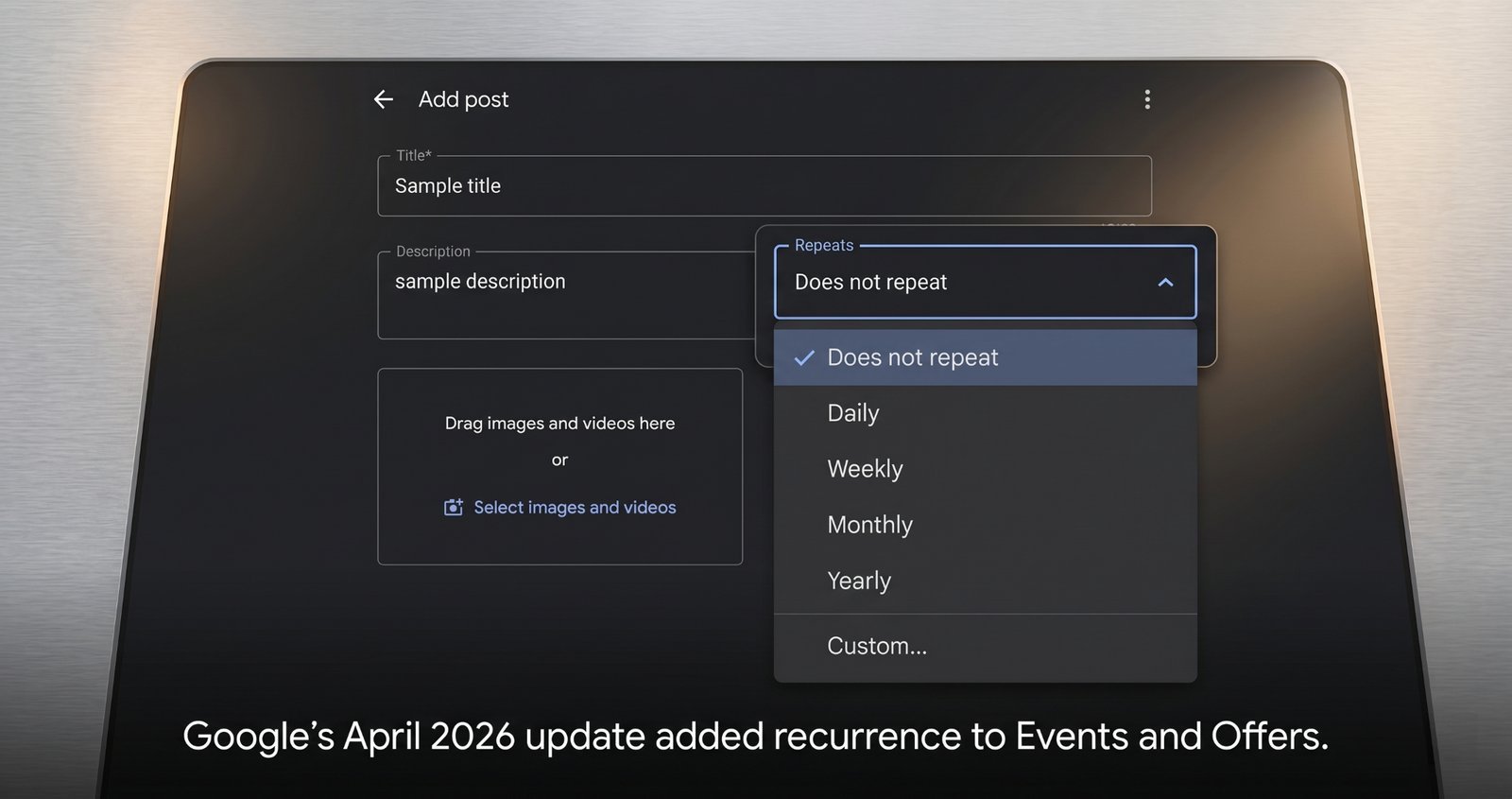
Google's April 2026 newsletter to Google Business Profile (GBP) managers led with a single definitive statistic. According to Google, businesses with complete and active profiles are 70% more likely to attract location visits.
That single stat carries a lot of weight. It serves as the core justification for two major product shifts introduced in that same newsletter: a renewed push for owners to fill out every single profile field, and a new Repeat dropdown feature for Posts that allows Events and Offers to re-publish automatically on a set schedule. Google anticipates that by simplifying profile activity, more small businesses will successfully clear the bar.
The reality of this update comes down to a shifting standard. Google's 70% figure is entirely real and worth your attention. However, maintaining a complete and active profile in 2026 requires meeting a significantly higher standard than it did two years ago. The new Repeat feature resolves only one small piece of the puzzle. Treating this feature as a basic automated shortcut will satisfy Google's automated freshness check. However, you will still lose visibility to competitors who keep their photos, customer reviews, and business attributes entirely up to date.
What Google actually said (and didn't)
The official directive from the April 2026 GBP newsletter states that "businesses with complete and active profiles are 70% more likely to attract location visits."
To understand how to leverage this data, you need to focus on two specific words: complete and active.
Google explicitly defines a complete profile within its official documentation. According to the Google Business Profile Help Centre, completeness means entering data into every single applicable field for your business type. This includes categories, hours, services, attributes, and photos. It goes far beyond the bare legal basics.
Conversely, Google leaves the term active completely undefined. The newsletter highlights the word but provides no specific parameters for what qualifies. This lack of clarity creates a challenge when you need to audit a client profile or evaluate your own performance. To solve this, we have defined precise operational benchmarks below.
"Complete and active" in 2024 vs. 2026 — the bar moved
Two years ago, a complete GBP required minimal maintenance. You needed an accurate business name, address, and phone number (NAP). Your hours had to be correct, your primary category needed to be selected, and you needed to upload a handful of photos alongside an occasional Post. Staying active simply meant your listing did not look entirely abandoned.
The modern local search environment demands much more. In 2026, a complete profile requires all the previous fundamentals plus an entirely updated attributes list, detailed service descriptions, specific product inventories, and accurately managed holiday hours. Staying active now requires publishing a Post every 30 days, uploading fresh photos every 30 days, generating customer reviews within the last 90 days, responding to those reviews consistently, and actively monitoring your public Q&A section.
Two distinct market shifts drove this change. Local search panels became intensely competitive. More local businesses filled out more available fields, which naturally raised the baseline standard across every industry. Simultaneously, Google updated its ranking systems to analyze freshness signals with much greater granularity. The system no longer tracks general activity; it evaluates specific types of recent updates.
🖼️ Image placeholder: Two-column comparison graphic showing the 2024 bar versus the 2026 bar for a complete and active GBP.
The CheckLocalSEO definition of "complete and active"
Because Google declines to provide an explicit threshold, we establish clear operational boundaries for local business owners.
Complete means every applicable field is filled
Categories: Your primary category remains your strongest optimisation lever. You must also add every relevant secondary category. Avoid aspirational choices; only select categories that reflect services you currently provide.
Attributes: Fill out the entire list of available traits, not just the highly obvious ones. Document details like wheelchair accessibility, accepted payment methods, identity attributes, and outdoor seating options. Local users frequently apply these exact traits as search filters within Google Maps. Ourcomprehensive guide to GBP attributes details exactly which selections influence visibility.
Services and Products: Avoid listing bare service names without context. Writing a clear, two-sentence description packed with terms your local customers actually search for yields far better results.
Hours of Operation: Outdated holiday hours stand as the fastest way to trigger a one-star review from an annoyed customer. Update your special hours quarterly without exception.
Active means signals of recent life
- Recent Posts: Publish at least one localized Post every 30 days.
- Fresh Imagery: Upload at least one original photo every 30 days. Prioritize your own internal photos over user-generated content.
- Review Management: Maintain incoming customer reviews within a 90-day window. Ensure you respond to all negative feedback quickly, though responding to all reviews remains the best approach. Ourguide on review response cadence outlines ideal timelines.
- Q&A Monitoring: Audit your public questions every 30 days. Business owners should provide authoritative answers to the top questions before random users fill in incorrect details.
Think of this list as your core optimisation checklist. Meeting every single one of these criteria ensures your profile remains genuinely complete and active under any rigorous interpretation of Google's standards.
🖼️ Image placeholder: Annotated screenshot of a GBP dashboard with arrows pointing at Posts, photos, reviews, and Q&A as the four active signals.
How the new Repeat feature fits in
The Repeat tool integrates directly into the Event and Offer post types. Based on Google's operational updates, this scheduling tool does not apply to standard Update posts. When building a qualified Post, you can access a recurrence selector to set weekly, monthly, or custom intervals alongside a firm expiration date.
This mechanism solves a major operational hurdle: the tendency to let profile updates slip for weeks at a time. Average Post adoption among local business owners remains low, and individuals who start posting frequently often stop within two months. The Repeat feature keeps your freshness metrics consistent without requiring a manual login every single week.
However, automation has clear limits. This tool does not generate new photos, manage incoming reviews, update business attributes, or answer user questions. Repeat serves as a useful administrative asset, but it represents exactly one checkbox on a much broader optimisation list. It functions purely as a scheduler rather than a local search strategist.
How to use Repeat without looking lazy
Vary Your Creative Assets: Create three or four distinct Offer or Event templates. Rotate these assets sequentially instead of looping a single post indefinitely. Real people read your profile panel. Displaying the exact same automated notice for months makes your business look managed by a script. OurGBP Posts best practices guide outlines highly effective visual and textual patterns.
Align Cadence with Real-World Events: Apply weekly recurrences exclusively to events that actually occur weekly, such as recurring trivia nights or weekly promotions. Use monthly settings for monthly milestones. Avoid artificially inflating your posting frequency to trick the algorithm.
Establish Expiration Dates: Set a firm end date and review your scheduled queue every single quarter. Relying on unmonitored automation can cause outdated information or expired promotional codes to remain live long after they end.
Audit Your Body Copy: Verify the text inside your automated queue. Running a recurring offer is completely acceptable, but accidentally running copy that mentions "spring specials" during the winter hurts your credibility.
A 10-minute audit you can run today
Open your active Google Business Profile dashboard in one browser tab, keep this checklist open in another, and verify each point systematically:
- Is your primary category selected as the most specific, accurate option available?
- Have you populated every single relevant secondary business category?
- Are all applicable business attributes fully checked and updated?
- Do your listed services or products feature unique, descriptive text?
- Are your standard and holiday operating hours completely verified for the next 90 days?
- Have you published a new public Post within the last 30 days?
- Have you uploaded an original business photo within the last 30 days?
- Have you provided clear responses to all customer reviews left within the last 90 days?
- Has an authorised manager provided answers to the top questions in your Q&A section?
- Have you established at least one recurring Post (Event or Offer) utilising varied creative layouts and a clear end date?
If you can check all ten items, your listing stands as completely optimised under Google's current local criteria.
The boring win
Google's 70% traffic metric highlights a very real opportunity for local business growth. The Repeat tool provides a highly practical operational assist, but it does not serve as a magic fix for local visibility. Securing a lasting competitive advantage in 2026 relies on executing repetitive, fundamental tasks. You win by building a profile that looks completely lived-in across every single operational signal Google measures.
Configure your first recurring Repeat post this week to automate your baseline frequency. Once that step is complete, immediately turn your attention to resolving the remaining nine items on your checklist.
To skip the manual work, you can run an instant analysis usingCheckLocalSEO's free audit tool to identify exactly which optimisation boxes your profile is already passing.