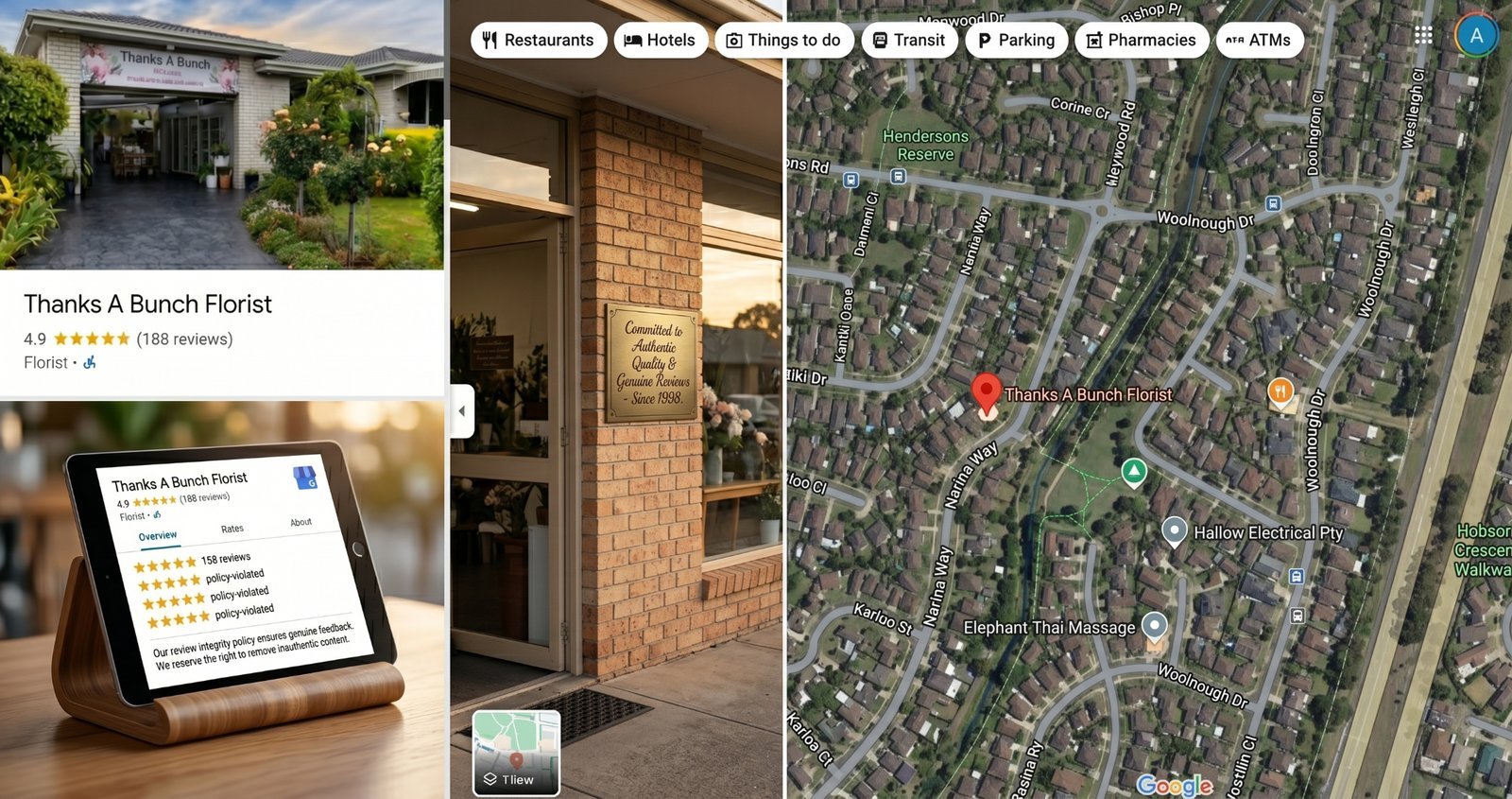
You wake up, open your Google Business Profile (GBP), and see eight new 1-star reviews overnight. None of the names matches your actual customers. Two reviews use identical wording. One profile belongs to someone who has never been within 500 miles of your storefront.
A year ago, your only real option was to start flagging reviews one by one, wait, and hope Google’s support team eventually noticed. In May 2026, Google rolled out an upgraded spam-review protection system that fundamentally alters this experience. The new workflow automatically detects review spikes, temporarily pauses new submissions, displays a public transparency banner to consumers, and alerts the profile owner.
While this marks a massive paradigm shift from the old per-review filtering approach, it introduces distinct edge cases that can sweep up legitimate reviews.
Here is exactly what to expect, how to handle an alert, and what the new transparency banner communicates to your market.
How the New System Works
Google framed this systemic change as a direct, aggressive response to localised review scams—specifically targeting the growing threat of review extortion.
From the official May 2026 Google Business Profile newsletter:
“We've upgraded our systems to be even faster at stopping scams — like attempts to demand payment in exchange for removing fake one-star reviews.”
The core operational details of the rollout followed immediately after:
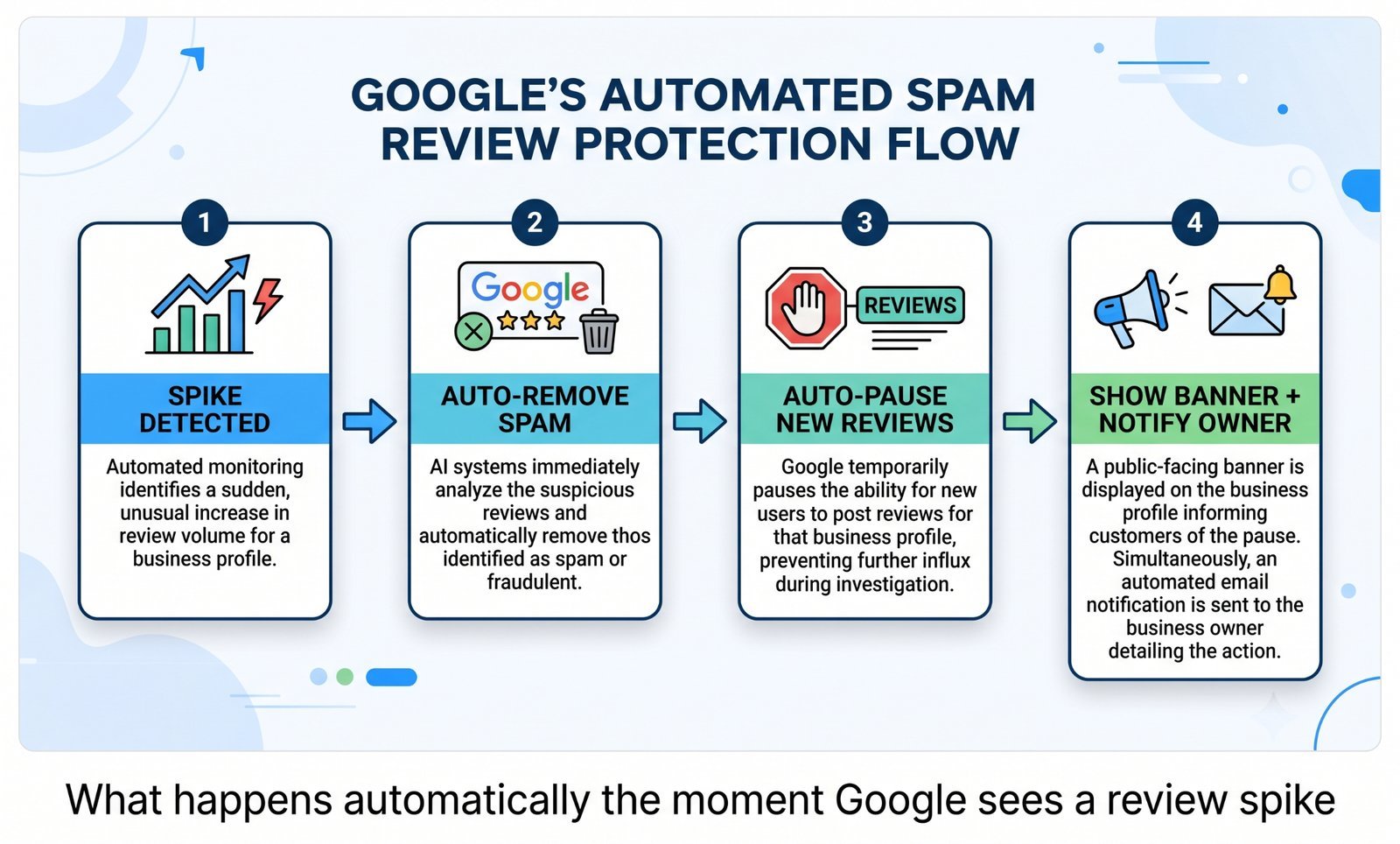
“If we detect a sudden spike in spam reviews, we'll quickly remove the fake content, pause new reviews on the profile, notify the Business Profile owner and display a transparency banner to let consumers know why contributions are temporarily paused.”
This represents a coordinated, system-level architecture split into four distinct automated mechanisms:
- Spike Detection: Google tracks review velocity patterns for every single listing. If a local business that typically averages three reviews a week suddenly receives 30 over a weekend, the algorithm flags the anomaly. A spike is not definitive proof of fraud; it is an automated signal that a profile requires immediate scrutiny.
- Auto-Removal: Once individual submissions are verified as fake by Google's underlying spam classifiers, they are stripped from the dashboard. This addresses high-volume bot nets, coordinated competitor sabotage, and extortion attempts.
- Auto-Pause: Rather than allowing an attack to compile while individual reviews wait in a manual support queue, Google temporarily locks the profile's ability to accept new submissions.
- Transparency Banner: Instead of silently freezing the profile, Google actively displays a notification on the public-facing local listing to contextualise the freeze for daily searchers.
- Owner Notification: Real-time dashboard alerts and automated emails ensure that verified merchants are immediately kept in the loop rather than being left to guess why their review volume hit a wall.
Google's broader position underlines that community feedback forms the fundamental trust layer of local search:
“Authentic community content helps your profile shine, and we take our responsibility seriously to keep this information trustworthy.”
This data carries significant economic weight. According to data from Google’s 2026 GBP Best Practices Playbook, 91% of consumers use online reviews to evaluate local businesses, and 65% of buyers state they are more likely to select a business that actively responds to its feedback.
When a profile is hit by an attack or a pause, it shifts from a cosmetic issue to a direct threat to customer acquisition.
What the Transparency Banner Actually Says (And Why It Matters)
While Google has not yet published the standardised, official banner layout in its public documentation, its core consumer-facing intent is entirely clear: eliminate the confusion caused by sudden review freezes.
Historically, when a business profile was quietly locked or restricted, it triggered severe communication blind spots. Customers viewing the page had no way to differentiate a protective measure from a manual penalty. They might easily assume the merchant was hiding bad press, manipulating their own scores, or facing regulatory issues.
The transparency banner completely reframes that perspective. It serves as an explicit public notice that Google’s trust and safety systems have proactively stepped in to secure the listing. For an establishment suffering through a wave of malicious 1-star reviews, this public acknowledgement turns a reputation threat into a subtle asset—openly showing that Google is defending the profile's integrity. It replaces operational silence with a clear institutional context.
What Gets Caught in the Pause (Including Legitimate Reviews)
The primary operational friction point for business owners is that the auto-pause mechanism acts as a blanket restriction. The system halts all incoming reviews on the profile during the designated spike window rather than selectively isolating only the suspicious submissions.
Consequently, entirely legitimate reviews from real patrons frequently get caught in the crossfire.
Consider a local restaurant featured in a viral community Reddit thread. If 200 users visit over the weekend and 50 of them decide to leave genuine reviews, that volume represents an exceptional, organic spike. Depending on the profile's baseline history, Google's cautious calibration may flag this burst as highly irregular and trigger a lock.
While the system is tuned to minimise false positives during organic viral moments, the risk remains real. Fortunately, these algorithmic pauses are designed to be temporary, typically resolving within hours to a few days.
Crucially, real reviews submitted while a profile is paused are not permanently rejected. They are held in a processing queue and generally populate publicly once the automated lock clears. If a customer mentions that their feedback isn't showing up immediately, advise them to wait a few business days for the system to normalise before attempting to resubmit.
What to do when you get the notification
- Maintain Baseline Operations: Avoid panic and do not confront recent customers. An automated spike alert indicates that the algorithm detected an anomalous data pattern—it does not mean your real-world clients are being called fraudulent.
- Analyse the Alert Parameters: Read the notification details closely to identify the specified trigger windows, the relative scale of the spike, and whether Google has already isolated and targeted specific reviews for removal.
- Document the Event Timeline: Take immediate screenshots of your merchant dashboard, your public local listing, and the active transparency banner. Keeping an immaculate timeline ensures you have the hard evidence required if you need to escalate a case to support later.
- Report Active Extortion Attempts: If you receive external direct messages or emails demanding payment to halt a 1-star attack, do not negotiate and never pay. Secure clear screenshots of the blackmail demands and immediately route them through the officialGoogle review extortion reporting form.
- Flag Competitor Sabotage Cleanly: If the wave stems from a local rival, utilize the standard merchant dashboard tools. Reference the officialGoogle review content policy and use theGoogle help docs on flagging reviews to submit individual review reports for human moderation.
- Avoid Artificial Counter-Spikes: Do not attempt to "outrun" a negative wave by mass-soliciting 5-star reviews from your email list in a single day. Forcing a sudden artificial burst of positive feedback will likely compound the issue and extend the automated algorithmic pause. Keep your review requests steady, continuous, and natural.
- Allow the System to Clear: Allow the automated window to run its course. Most early field observations indicate that the public banner and listing restrictions drop automatically once the background data validation concludes.
For Agencies and Reputation Managers
For digital marketing agencies managing clients in highly competitive, spam-prone niches—such as home contractors, hospitality, medical clinics, or legal services—proactive education is vital. Briefing your clients on this automated architecture before an incident occurs changes a frantic emergency phone call into a controlled, standard operating procedure.
This shift heavily dilutes the value proposition of predatory "review removal services" that promise instant, black-box deletions. Because Google is handling baseline spam identification algorithmically at scale, agency value now centres on accurate diagnosis, timeline documentation, formal support escalations, and preventing clients from making knee-jerk mistakes.
Incorporate a standardised spam escalation playbook into your account management workflows:
- Establish clear parameters on who monitors profile velocity daily.
- Define who logs and screenshots extortion messages.
- Set expectations for managing review request systems during an active pause.
For deeper context on shifting local search guidelines, read our comprehensive breakdown onanonymous Google reviews one year on.
One Month In — What We Know So Far
Because this update has only been live for roughly four weeks, field observations from local SEO networks should be viewed as an evolving baseline:
- False Positives Occur: Real-world reports confirm that fast, organic bursts of legitimate customer reviews are occasionally getting caught in the protective net.
- The Banner is Actively Deploying: The public notification is appearing on live maps profiles globally, signalling that automated enforcement is fully integrated.
- Data Release is Pending: Google has not yet shared global metrics regarding total spam volumes intercepted by this specific upgrade. Historically, broader enforcement and trust data are shared three to six months following a system rollout.
Ultimately, the update has not completely eliminated review manipulation overnight, but it has drastically raised the floor, making rapid-fire negative review blasts and digital extortion vastly more difficult to pull off.
The Bottom Line
This represents the most protective, merchant-centric change Google has introduced to the review ecosystem in years. The operational upsides—near-real-time responses, clear consumer-facing context, and transparent merchant notifications—far outweigh the temporary inconveniences of the false-positive edge cases.
The smartest strategy is to understand the mechanics before your profile is ever targeted. Know what the banner signifies, preserve your evidence, and never attempt to fix a velocity anomaly by creating an even larger review spike.
Want to check your risk profile? Run a free local visibility audit atchecklocalseo.com—we will flag the underlying review distribution and velocity patterns that could accidentally trigger Google’s automated spike protections.
Questions about what the audit covers? The FAQ and the feature overview have the details.