Vibe is now a local SEO signal. Stop optimising for keywords, start optimising for atmosphere.
Someone is going to type this into Google Maps tonight: "cosy vegan-friendly spot for 4 at 7 pm, somewhere we can actually hear each other."
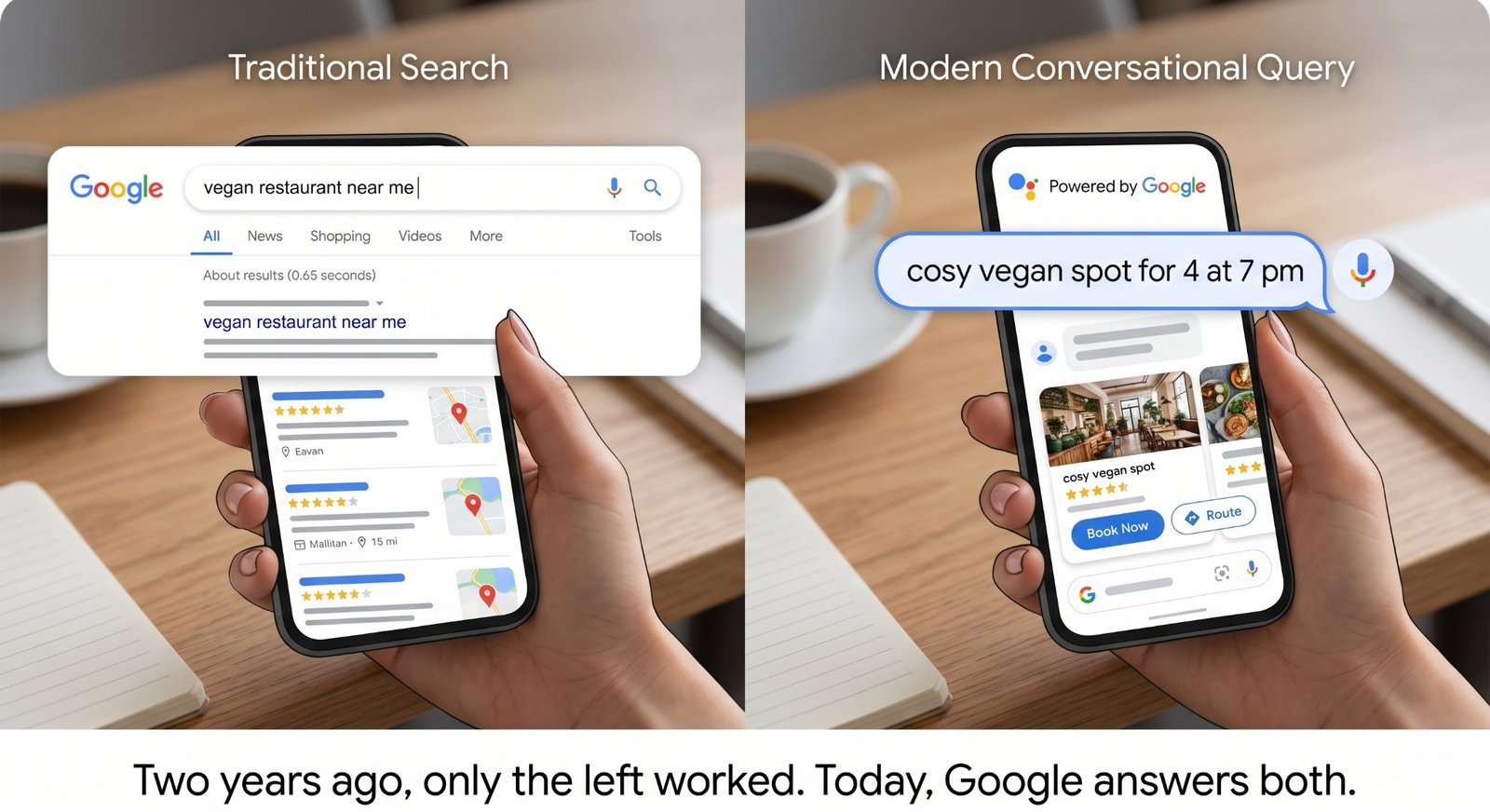
Two years ago, Google would have shrugged at that sentence and returned a generic list of vegan restaurants sorted strictly by proximity. Today, inside Ask Maps, it answers the whole query. It maps atmosphere, dietary fit, party size, time, and noise level instantly. It delivers these answers by reading your Google Business Profile (GBP) in a completely new way.
Here is the shift: local SEO used to be about telling Google what your business is. With Ask Maps, it is about telling Google what your business feels like — and proving it across reviews, photos, and attributes so an AI can match you to a query no human would have typed two years ago. Vibe isn't just an abstract concept anymore. It is a signal. And signals can be audited.
Two years ago, only the left worked. Today, Google answers both.
What Ask Maps actually does (and why it changes the brief)
Ask Maps isn't a chat skin built on top of classic local search. It is a fundamental retrieval shift. When someone types a conversational query, Google decomposes that intent into distinct pieces. It separates atmosphere, dietary choices, party size, and real-time availability. Then, it pulls both structured data and unstructured data from your listing to find a precise match.
TheApril 2026 GBP newsletter was the first time Google publicly admitted what was already happening under the hood. Review text is being parsed for atmosphere terms. Photos are being scanned to verify the attributes you have claimed. According to Google's official update, outdated or incomplete profiles will remain "invisible to these conversational queries."
Invisible. That is the word. Not "ranked lower." Invisible. A profile with thin reviews, three photos of the storefront, and half its attributes blank cannot be matched to a conversational query. This remains true even when the category and business name are spot-on.
Reviews used to be counted. Now they are read.
The reframe: from what you do to what you feel like
The old local SEO checklist still matters. Your category, name, address, and phone number are not going away. But these elements are table stakes now. They get you into the candidate pool. They do not get you matched.
The differentiator is whether an AI can build a sensory profile of your place from what you have published. Can it tell that you are quiet on weeknights and lively on weekends? Does it know your patio actually has heaters? Can it verify that your entrance has an accessibility ramp?
"Vibe" sounds soft. We know. But it is a composite of measurable inputs. The parts that feel immeasurable are exactly the parts Google has started measuring.
The four signals Google uses to read your vibe
1. Review text (atmosphere coverage)
When a customer writes "great spot for a date night, super quiet in the back," those words become query-matchable phrases. Reviews mentioning terms like "cosy," "loud," "kid-friendly," or "quick lunch" feed directly into Ask Maps matching algorithms.
This changes what you ask customers for. Stop asking, "Can you leave us a review?" That only gets you generic stars and one-liners. Start asking open-ended questions that elicit atmosphere.
2. Photos (feature verification)
Google now cross-checks your attribute claims against your photo evidence. If you select "outdoor seating," your photos must show outdoor seating. If you claim "wheelchair accessible," a visible ramp or step-free entrance helps confirm it. A mismatch between your selections and your photos reduces overall match confidence.
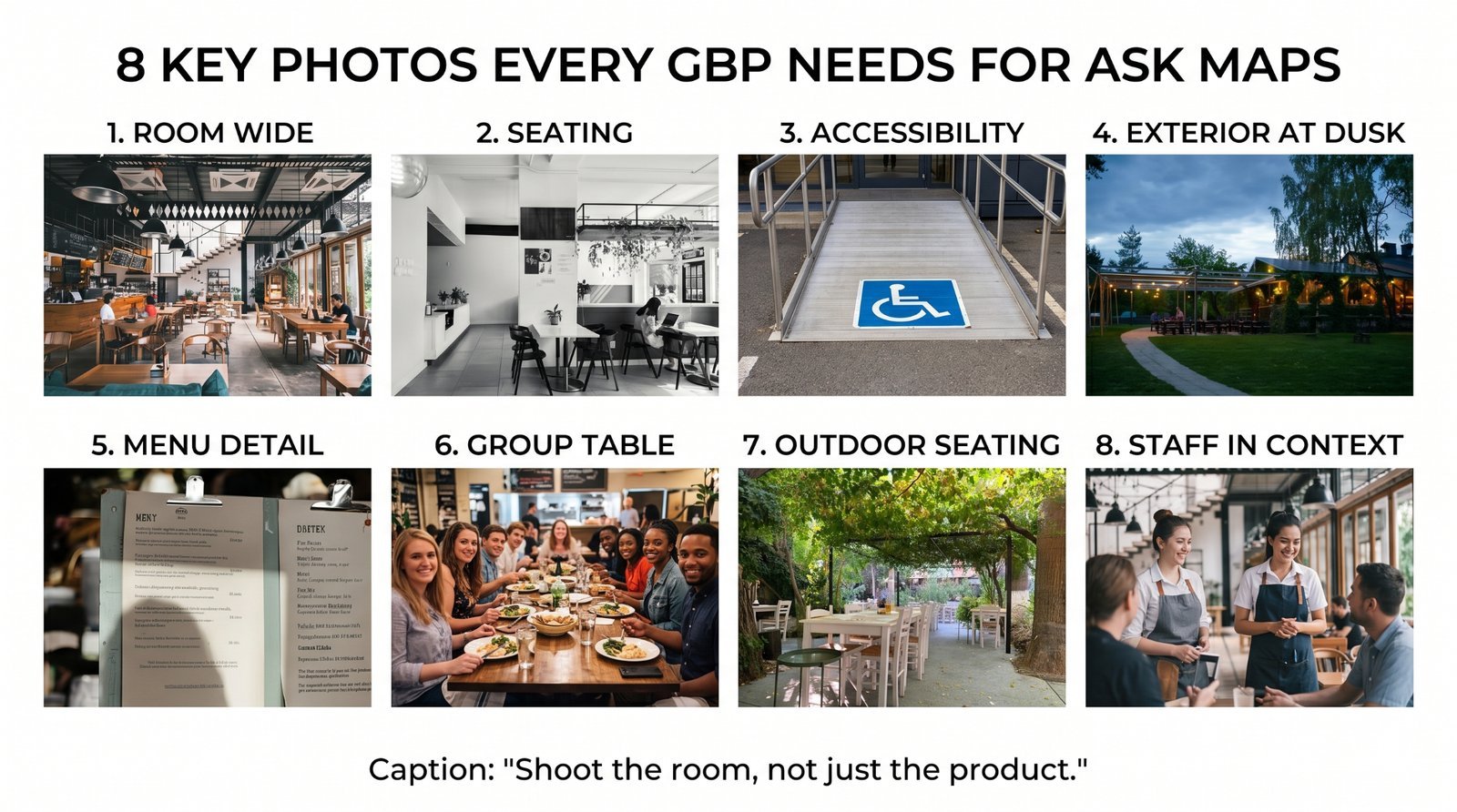
The practical move: shoot the room, not just the product. A plate of food doesn't tell Ask Maps you have the right lighting for a first date. A wide shot of the dining room at 7 pm does.
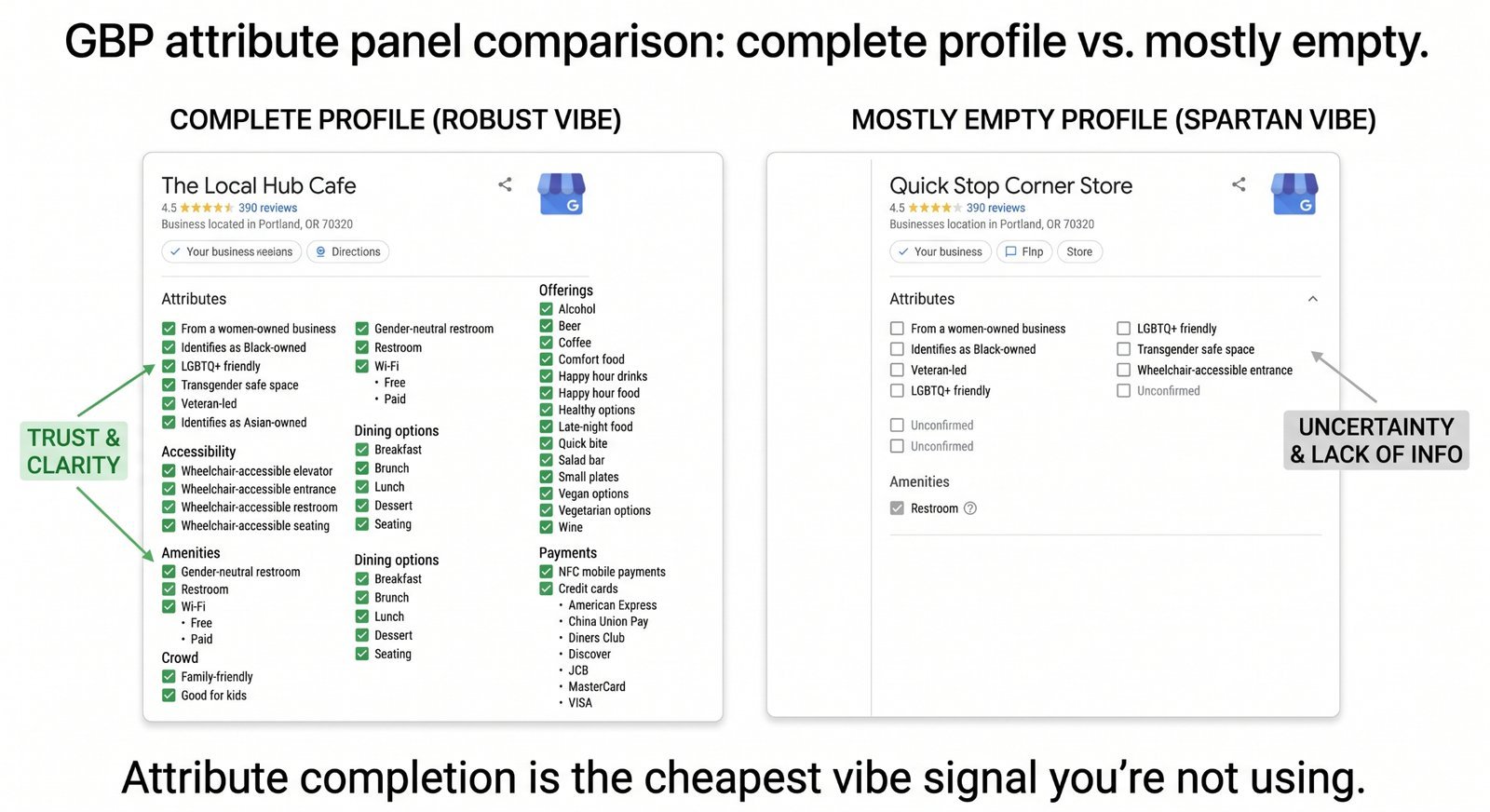
Attribute completion is the cheapest vibe signal you're not using.
3. Attributes (the checkboxes most owners ignore)
Attribute completion is the cheapest, fastest vibe signal you have. Most profiles leave this opportunity completely on the table. Every blank attribute represents a conversational query you cannot answer.
Go through every single attribute, includingevery attribute, including the ones that feel obvious. Mark fields for "restroom," "good for working," "casual," or "family-friendly." The details are obvious to you, but they are completely invisible to a retrieval system with nothing else to read. You can update these directly via Google's officialattributes documentation.
4. Real-time data (hours, busyness, menu freshness)
A time-specific query like "at 7 pm tonight" only works if Google knows your exact hours. Holiday hours, special events, or an unrecorded closure will remove you from time-bound queries entirely. Furthermore, if your digital menu has not been updated since February, your attributes fight against stale evidence.
How to prove your vibe (a 20-minute audit)
Front-load this work. Most of it can be completed in a single sitting.
Send customers a follow-up that asks a specific question instead of requesting a generic favour. Here are three review prompts we have seen pull atmosphere language reliably:
- "What was the vibe like when you walked in?"
- "Who would you recommend us to — a date, family, solo, or a group?"
- "Did anything surprise you about the layout of our space?"
You can prompt for atmosphere. You cannot script the answer. That is the line.
Photo shoot list.
Spend an afternoon capturing these eight essential images to help you shoot the room, not just the product:
- A wide shot of the main room showing the layout.
- The seating area during peak operating hours.
- The main entrance shows clear accessibility features.
- The exterior of the building at the time of day people typically visit.
- A group table set up for four or more guests.
- Outdoor seating options, if available.
- A clear, close-up detail of your physical menu.
- Your team is interacting in context with a customer.
Shoot the room, not just the product.
Attribute pass.
Open every section in your GBP dashboard. Check every box that is accurately true today. Uncheck anything that is no longer true. Stale claims hurt more than missing ones because they create a data mismatch. Finally, update your holiday hours for the next 90 days and verify your digital menu is accurate.
Hours and menu sanity check.
Update holiday hours for the next 90 days. Confirm your menu reflects what's actually served this season. If you have a busy night that isn't showing up in Google's popular-times data, prompt a few regulars to check in.
Frequently Asked Questions
Does this mean keywords don't matter anymore?
No. Your primary business category and name still anchor the basics of local search. However, for conversational queries, keywords are no longer enough. You must have the sensory layer to match natural language intent.
How long does it take for review or photo changes to show up in Ask Maps results?
Google has not stated an exact refresh cadence publicly. Anecdotally, attribute changes appear to update faster than machine-learning processing of unstructured review text.
Can I prompt customers to use specific words in reviews?
You can prompt them to describe the atmosphere, which is entirely fair. You cannot script or dictate their actual reviews. The boundary lies between asking an open-ended question and feeding them a forced answer.
What if my business genuinely doesn't have a traditional "vibe" — like a plumber or a notary?
Vibe in the context of Ask Maps translates directly to situational fit. For a service provider, your vibe consists of phrases like "emergency availability," "honest pricing," or "explains the work clearly." The signals are identical; only the vocabulary changes.
Will photo authenticity ever be verified beyond attribute matching?
Google has not commented on this publicly. However, the technical direction is clear. Multimodal AI verification is active, so assume your photos will be algorithmically cross-checked against your business claims.
What this means for the audit
CheckLocalSEO now scores vibe legibility as a composite — attribute richness, review coverage of atmosphere and accessibility and seating language, photo subject variety, and real-time data freshness. It's the same four signals above, scored against what we see across audited profiles.
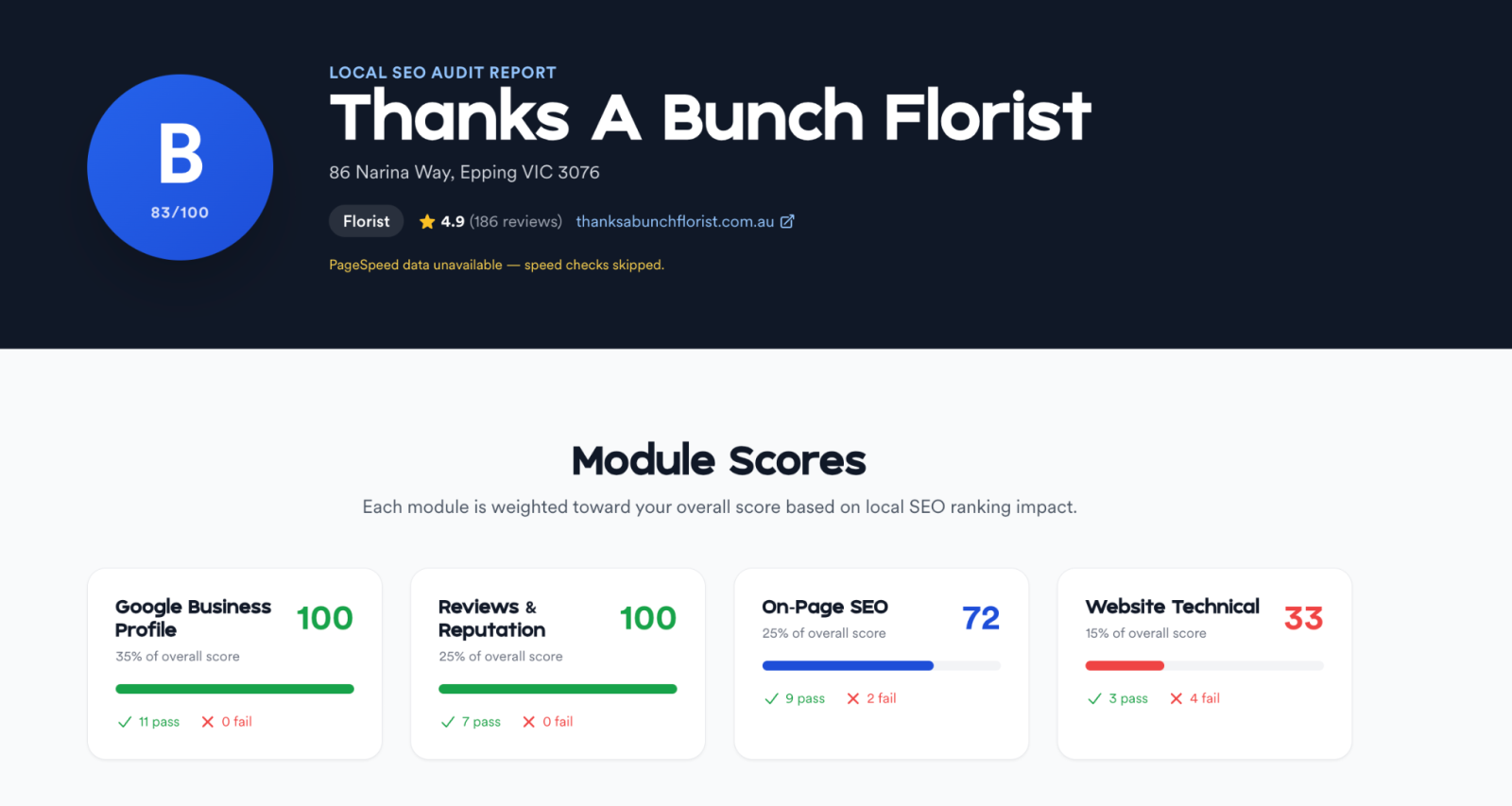
One link, no upsell. Run it on your own profile first.
The opinion landing
The businesses that win in the Ask Maps era will not be the ones with the most reviews. They will be the ones whose reviews, photos, and attributes tell the exact same story.
The cosy spot whose reviews say "cosy," whose photos show warm lighting, whose attributes confirm "good for date night," and whose hours reflect a 7 pm Tuesday will get matched. The profile with 800 four-star reviews and a single, outdated storefront photo will not.
Vibe is a signal. Treat it like one.
Run a free audit on your GBP at CheckLocalSEO and see how legible your vibe is to Ask Maps.
See everything the audit scores, or read the FAQ if you are new to local SEO audits.